
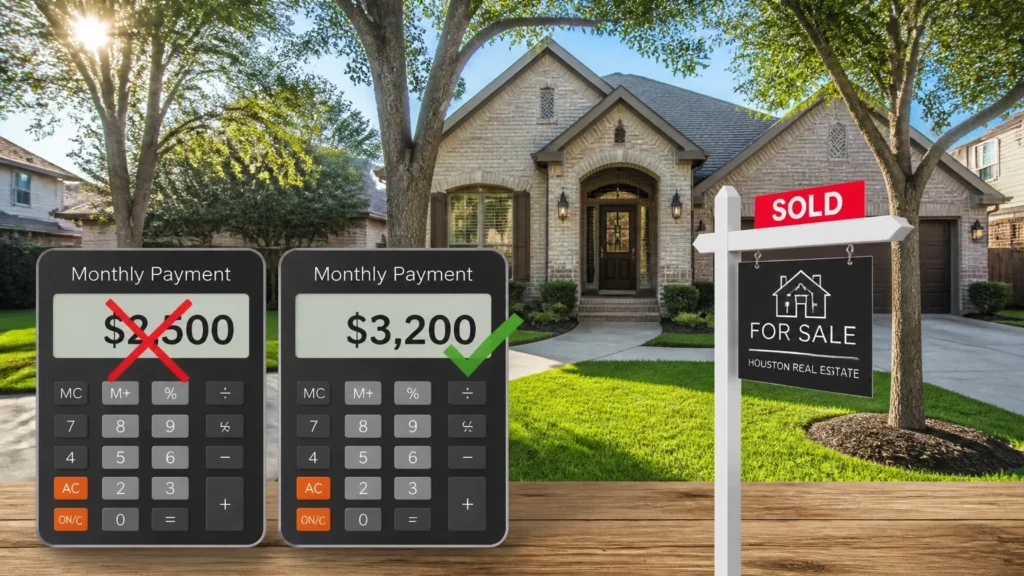
Hey there! It’s Nasir, your friendly neighborhood "Realtor Daddy." If you’ve been scrolling through Zillow or Redfin at 2:00 AM (don’t worry, we all do it), you’ve probably seen that tempting "Estimated Monthly Payment" box. It looks so reasonable, right? You see a $450,000 house in Katy and think, "Hey, I can swing $2,800 a month!"
But here is the reality check: If you rely on a generic online mortgage calculator for a home in the Houston area, you’re probably looking at a "surprise" bill that could cost you an extra $500 to $800 every single month.
In Houston, Katy, Cypress, and Sugar Land, property tax math isn’t just a detail, it’s the difference between living comfortably and being "house poor." Let’s break down why those online estimates are lying to you and how we can get the real numbers.
The "1% Fallacy": Why National Calculators Fail Houston
Most big-name mortgage calculators are built for the national average. In many states, property taxes hover around 1% of the home's value. If a calculator defaults to that 1% rate, it’s going to tell you that the taxes on a $400,000 home are about $4,000 a year ($333 a month).
Here is the Houston reality: Our effective tax rates usually land between 2.1% and 3.2%.
That same $400,000 home in a new-build community in Cypress might actually have a tax bill of $11,000 or more. That’s nearly $1,000 a month just for taxes. If your budget was based on that $333 estimate, your bank account is going to feel a very painful pinch on closing day.
If you're a first-timer, check out my essential tips for first-time homebuyers in Houston to avoid these common traps.
Alphabet Soup: MUDs, PUDs, and ISDs
Why are our taxes so high compared to other places? Well, in Texas, we don't have a state income tax (yay!). But the money for schools, roads, and water has to come from somewhere (boo!).
In our neck of the woods, your tax bill is a "layered cake" of different entities. You aren’t just paying "Houston taxes." You’re paying:
- The County: Harris, Fort Bend, or Waller.
- The School District (ISD): Like Katy ISD or Cy-Fair ISD.
- The City: If you’re within city limits.
- The MUD (Municipal Utility District): This is the big one.

What is a MUD?
If you’re looking at a beautiful new home in a master-planned community in Fulshear or Katy, you’re almost certainly in a MUD. These districts were created to fund the infrastructure (pipes, sewers, drainage) for new neighborhoods.
MUD taxes can add 0.5% to 1.5% to your total tax rate. Most online calculators have no idea what a MUD is, so they leave it out entirely. This is why having a local realtor who knows the area is non-negotiable. I can look up the specific MUD for any address and tell you exactly what you're getting into.
The 2026 Secret Weapon: The $140,000 Homestead Exemption
It’s not all bad news! While the rates are high, Texas gives homeowners a massive break through the Homestead Exemption.
As of right now, in June 2026, the school district homestead exemption has been bumped up to $140,000. That means if your home is appraised at $400,000, you only pay school taxes on $260,000 of that value. Since school taxes are often the biggest chunk of your bill, this saves you thousands.
But here’s the catch: Online calculators don’t know if you’re going to live in the house or rent it out. They don’t apply that exemption for you. Also, if you’re buying a home from someone who has lived there for 20 years, their taxes are "capped" by a 10% annual limit. When you buy it, the appraisal might "reset" to the full purchase price, and your bill will jump.
Katy vs. Cypress vs. Sugar Land: A Quick Look
Every area has its own flavor and its own tax rate. Here’s a rough guide for your 2026 planning:
- Katy (Harris County side): Expect rates around 2.5% to 3.0% in many MUD-heavy areas. Katy ISD is world-class, but that quality shows up on the tax bill!
- Cypress: Generally sits between 2.2% and 2.8%. You get a lot of house for your money here, but keep an eye on those special districts.
- Sugar Land: Often feels a bit more established. Rates here can range from 2.0% to 2.5%, depending on if you're in an older area or a newer development like Riverstone.

To find the right fit for your budget, you might want to look at my guide on top tips to buy your dream home in Texas.
How "Realtor Daddy" Gets the Math Right
When we sit down to look at homes, I don't just show you the kitchen and the backyard. We look at the "Total Cost of Ownership." Here is how I help my clients avoid the "Tax Trap":
- Address-Specific Research: I pull the actual tax records for every home you’re serious about. No guessing.
- MUD Analysis: I’ll tell you if the MUD tax is scheduled to go down (they often do as the debt is paid off!).
- The "New Value" Estimate: I calculate what your taxes will look like after the appraisal district sees your purchase price.
- Homestead Planning: I’ll make sure you know exactly when and how to file for your exemption to get that $140,000 credit.

Don't let a generic website determine your financial future. Property tax math matters, and getting it wrong can turn your dream home into a financial headache.
Want a "No-Surprises" budget for your move to Katy, Cypress, or Sugar Land? Let's chat! I’m here to make sure your transition is as stress-free as possible.
FAQ: Houston Property Tax Edition
1. Why is my monthly mortgage payment higher than the online estimate?
Generic online calculators often use a 1% or 1.2% national average tax rate. In the Houston area, rates are often double or triple that, especially if the home is in a Municipal Utility District (MUD).
2. What is a MUD tax, and do I have to pay it forever?
A MUD (Municipal Utility District) tax pays for the neighborhood's water, sewer, and drainage infrastructure. While you do have to pay it as long as you own the home, MUD rates often decrease over time as the district's bonds are paid off.
3. How do I get the $140,000 school tax exemption in 2026?
You must file a Homestead Exemption with your county appraisal district (like HCAD for Harris County). It must be your primary residence, and you generally file between January 1st and April 30th of the year after you purchase the home.
4. Will my property taxes go up right after I buy the house?
In Texas, your taxable value is usually "reset" the year after a sale to reflect the market value (often the purchase price). If the previous owner had a homestead exemption for a long time, their value might have been capped much lower than what you paid, leading to a significant tax increase for you.
5. Are property taxes lower in Katy or Sugar Land?
It depends on the specific neighborhood! Older, established areas in Sugar Land may have lower rates (around 2.0-2.2%), while newer master-planned communities in Katy or Cypress with high-end amenities and new MUDs can see rates of 2.8% to 3.2%.